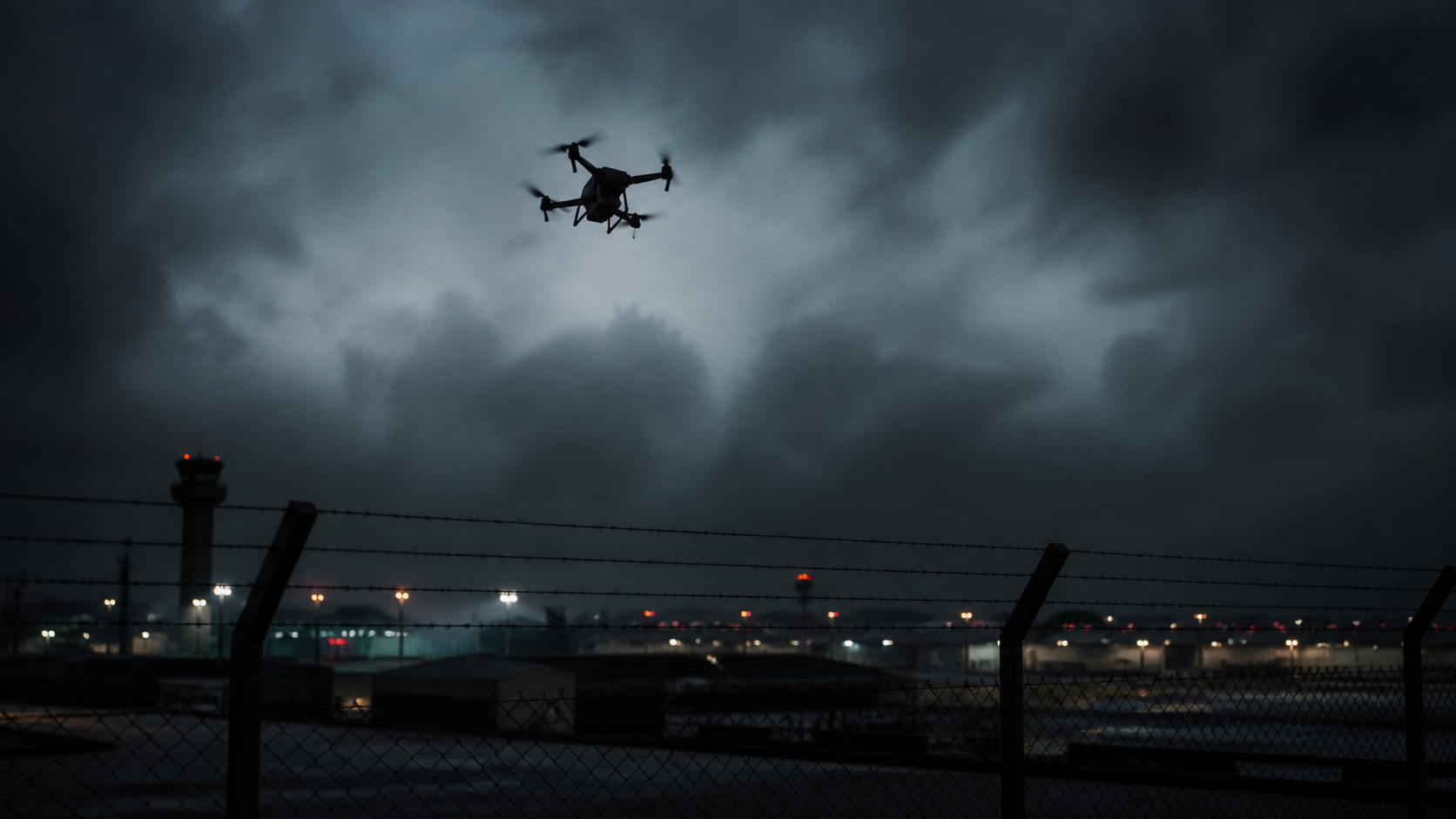
The operational doctrine for countering unmanned aerial systems (UAS) has fundamentally shifted in 2025. What began as a kinetic-first mindset—shooting down drones with missiles and kinetic rounds—has given way to a spectrum of precision, reversible, and economically rational soft-kill methodologies. This transition reflects both tactical evolution and the strategic imperative to preserve airspace for legitimate operations.
The Decline of Kinetic Engagement
Kinetic solutions remain expensive and indiscriminate. A single $50,000 air-to-air missile to neutralize a $500 commercial drone creates an unsustainable cost asymmetry. More critically, kinetic engagement leaves debris, complicates civilian airspace management, and often requires military-grade air defense systems positioned far from where threats emerge—at borders, airports, and critical infrastructure nodes.
The 2024 airport incursions across North America and Europe demonstrated the inadequacy of purely kinetic doctrine. Threats that loop through populated zones cannot be engaged with missiles. Operators needed solutions that were precise, repeatable, and rapid—without collateral consequences.
Soft-Kill Technologies: The New Standard
Soft-kill systems—RF jamming, spoofing, and electronic countermeasures—have matured to the point where they now represent the first line of defense at virtually every contested perimeter. These systems operate at the source: they degrade, distort, or redirect the command and control (C2) signals that bind the operator to the aircraft.
Remote Electronic Warfare (REW) platforms jam GPS and C2 channels simultaneously, forcing drones into autonomous failsafe modes (typically return-to-home) within seconds. Detection-to-effect time drops to under 2 seconds for systems with over-the-horizon awareness.
Spoofing technologies take this further: they don't simply jam—they masquerade as legitimate signals. A drone operator receives false telemetry, false GPS coordinates, or false geofencing boundaries. The result is a controlled redirect, not a crash. Some advanced systems can even inherit the drone into a secure holding pattern, where ground teams assess threat level before choosing final disposition.
Cyber Over RF: The Emerging Frontier
The most significant advancement in counter-UAS doctrine involves Cyber Over RF (COR) takeover techniques. These exploit the firmware vulnerability chain in commercial drone autopilots. By transmitting a specifically crafted RF packet that satisfies the drone's signal authentication checks, attackers can assume command authority and steer the aircraft to a designated landing zone.
This represents genuine dominance: not disruption, but operational capture. Intelligence agencies prize COR precisely for this reason—a recovered drone's flight logs, battery, and payload may reveal operator identity, intent, and launching location.
Implementation in 2025
Pegasus Counter-UAS systems integrate all three methodologies into a unified C2I architecture. Our RF sensor network provides 360° detection within 30km range. Upon threat classification, operators can select their response: jam, spoof, or assume control. This layered doctrine ensures that every threat has a reversible, economy-conscious response proportional to assessed risk.
The shift from kinetic to soft-kill is not merely technical—it is doctrinal. Airspace is a shared resource. The only sustainable defense is one that preserves that resource for all legitimate operators.
"Kinetic doctrine assumed an empty airspace. Soft-kill doctrine assumes a contested, populated one. That is the operational reality of 2025."