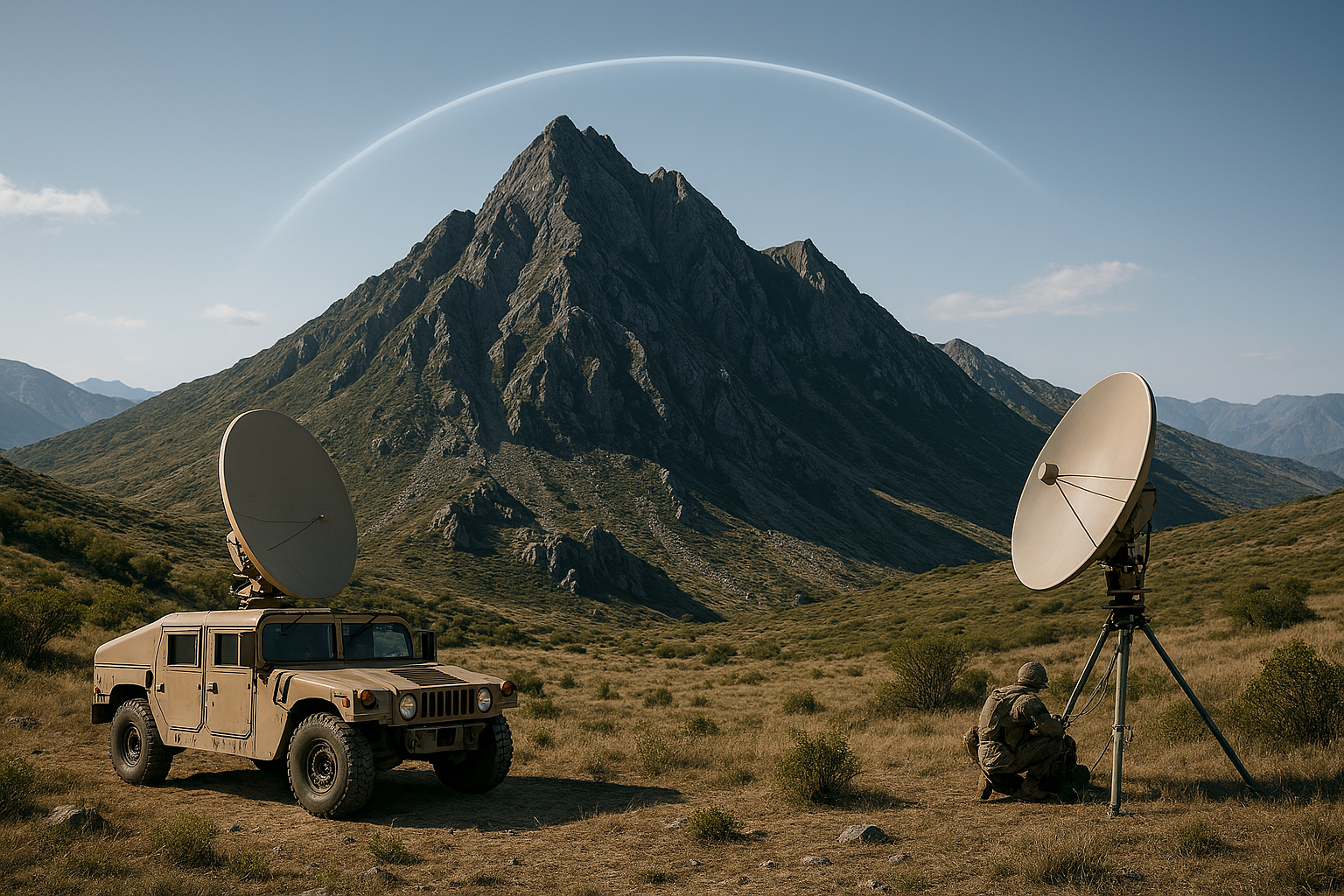
In the strategic geography of 2025, contested environments fall into two categories: those with intact satellite infrastructure, and those without. Locations in the latter category—remote mountain ranges, polar regions, areas under active electronic warfare, and countries under communication embargo—require a communications architecture that does not depend on space-based relays or terrestrial fiber networks.
For these scenarios, there is no alternative to troposcatter.
What Is Troposcatter?
Troposcatter (tropospheric scatter) is a technique by which radio waves in the UHF and lower microband frequencies are transmitted at a shallow angle into the troposphere (the lowest atmospheric layer, typically 0-15km altitude). These signals scatter off density irregularities in the troposphere—primarily at the point where warm and cool air masses meet—and are received hundreds of kilometers away, completely beyond line-of-sight.
Unlike satellite communications, troposcatter requires no orbiting assets. Unlike ionospheric skip propagation (HF), it does not depend on unpredictable solar cycles. Troposcatter is deterministic, bandwidth-flexible, and inherently difficult to jam without proximity to either the transmitter or receiver.
Advantages Over Satellite in Austere Environments
1. Resilience to Embargo and Interdiction
A nation or coalition cannot disable troposcatter links through diplomatic pressure or sanctions, as they can with commercial satellite operators. Pegasus operates terrestrial troposcatter networks that are entirely independent of third-party infrastructure.
2. Low Latency for Time-Critical Operations
Satellite uplink introduces 250-500ms of round-trip latency. Troposcatter achieves 50-150ms. For command-and-control (C2) in fast-moving tactical scenarios, this difference is operationally decisive.
3. Inherited Jamming Hardness
Jamming a troposcatter link requires a jammer co-located or nearly co-located with either the transmitter or receiver. This makes troposcatter inherently resistant to standoff jamming—an adversary must physically approach your position to degrade your signal, thus revealing their presence.
4. No Orbital Dependency
In theaters where space domain awareness (SDA) is contested—where adversary ASAT capabilities are credible threats—troposcatter is immune. Your communications cannot be severed by an adversary kinetic strike against satellite constellations.
Range, Bandwidth, and Capacity Trade-offs
Troposcatter cannot achieve satellite bandwidth. A single troposcatter link typically provides 2-8 Mbps of goodput, depending on weather, antenna gain, and transmitted power. This is sufficient for:
- Real-time video at compressed bitrates (480p-720p)
- Encrypted voice and data for small operations cells
- Intelligence dissemination to forward-deployed teams
- Command authority transmission for distributed forces
For very long-range links (600+ km), capacity drops; for shorter ranges (150-300 km), capacity improves. The relationship is predictable and can be pre-engineered into an operations plan.
Network Architecture: Hub and Spoke
Pegasus terrestrial network architecture deploys a hub-and-spoke model. The hub (typically at a coalition operations center or strategic command node) operates multiple troposcatter transmitters spanning 300-500km radius. Remote operating bases, forward logistics sites, and forward observation posts operate receiving terminals that can be deployed, hidden, and repositioned within hours.
Because troposcatter terminals are powered by solar and battery systems, they can operate in regions with no power grid. A six-person forward team can maintain C2 connectivity across a 400km battlespace using equipment that weighs less than 100kg.
The Human Factor: Trained Operators Required
Troposcatter networks require trained RF operators who understand atmospheric conditions, propagation prediction, and frequency coordination. This is not plug-and-play technology. But in austere operational environments, the operators who will be using the system are already highly trained; adding troposcatter network discipline to their regimen is straightforward.
The Strategic Imperative
As peer competitors develop ASAT capabilities and contested regions become electronically saturated, troposcatter transitions from niche technology to mission-critical infrastructure. Pegasus Terrestrial Wireless solutions ensure that command, control, and intelligence flow to your people, everywhere, everywhen, regardless of orbital or terrestrial infrastructure status.
"In a contested environment, infrastructure you don't own can be turned off. Troposcatter is infrastructure only you control."