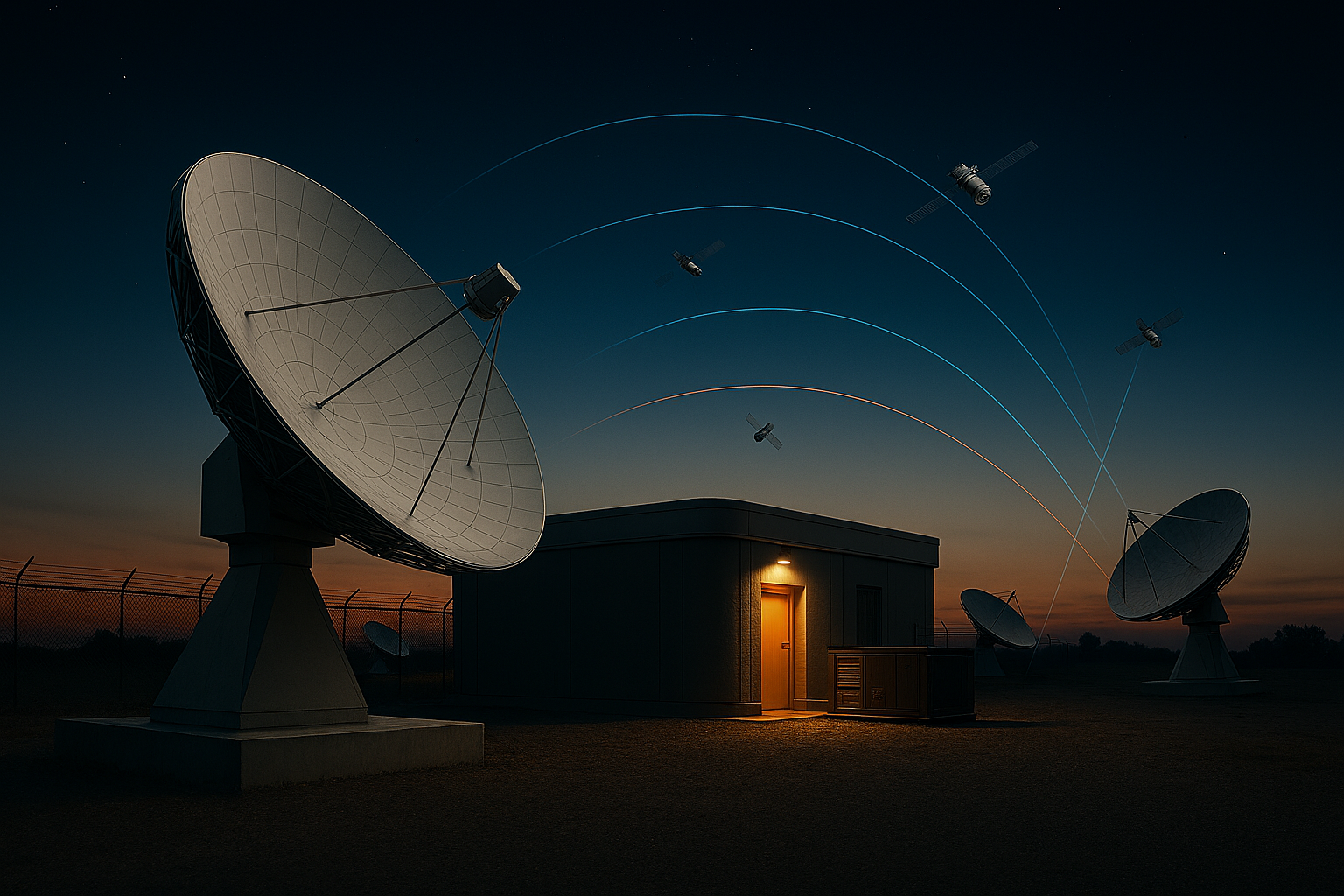
The explosive growth of Non-Geostationary Orbit (NGSO) satellite constellations has fundamentally reshaped the electromagnetic spectrum landscape. As of early 2025, over 8,000 active satellites are operating in Low Earth Orbit (LEO), Medium Earth Orbit (MEO), and High Elliptical Orbit (HEO) regimes. This represents a staggering increase from fewer than 300 operational satellites just five years ago.
For spectrum regulators, national security operators, and commercial telecom providers, this constellation growth creates an unprecedented monitoring and deconfliction challenge.
The Scale of the Problem
Starlink alone operates over 6,000 satellites. OneWeb maintains a constellation of approximately 600 operational spacecraft, with plans to expand to 2,000. China's Qianfan constellation—designed to provide secure, ITAR-free satellite communications to Belt and Road Initiative partners—is ramping up deployment at an accelerated pace.
Each satellite transmits across multiple frequency bands: Ku-band, Ka-band, and increasingly, millimeter-wave X-band. The sheer RF density in these bands has created what spectrum engineers call "congestion zones"—orbital slots and frequency allocations where interference from neighboring constellations is nearly inevitable without real-time coordination.
Regulatory Fragmentation
The International Telecommunication Union (ITU) established coordination frameworks in 2020, but enforcement remains voluntary. National regulators—the FCC, OFCOM, ISRO, and China's MIIT—each maintain separate filing databases and coordination protocols. A satellite approved in one jurisdiction may create interference in another with little recourse for victims.
Defense operators are particularly vulnerable. Military communications often occupy adjacent frequency bands to commercial NGSO operators. In 2024, three documented cases occurred where Starlink satellite passes interfered with naval radar systems during critical operational windows. In each instance, real-time spectrum awareness was the only effective mitigation.
Real-Time Constellation Monitoring
Pegasus Space Domain Awareness (SDA) systems now integrate real-time orbital mechanics with RF emission tracking. Our platform ingest Satellite Catalog (SATCAT) data, Two-Line Element (TLE) sets, and RF telemetry from distributed monitoring sensors to build a live 3D model of constellation geometry, frequency allocations, and predicted interference windows.
Key capabilities:
- Orbital prediction: 72-hour forward prediction of satellite passes over any ground location
- Frequency mapping: Real-time mapping of active RF transmitters to orbital position
- Interference prediction: Probabilistic forecasting of interference events with 87% accuracy
- Deconfliction alerting: Automatic notifications to operators when military-protected spectrum faces imminent NGSO interference
The Business Case for Defense SDA
For procurement offices, the ROI is stark. A single instance of unplanned spectrum interference during a critical mission—a naval engagement, a border interdiction, a humanitarian response—can cost tens of millions in lost operational effectiveness. Pegasus SDA systems cost a fraction of that. They transform spectrum from a passive environment into an actively monitored, predictable operational domain.
More strategically, constellation growth will only accelerate. By 2030, analysts project 15,000+ NGSO satellites in orbit. Without investment in real-time monitoring and coordination infrastructure, national security operators will find their spectrum increasingly contested and increasingly unpredictable.
The operators who invest in constellation visibility now will retain spectrum dominance in the contested environments of tomorrow.